Patterns of Nationhood and Saving the State in Turkey by Serhun Al
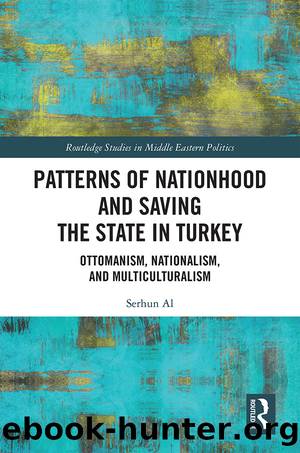
Author:Serhun Al [Al, Serhun]
Language: eng
Format: epub
Tags: History, Middle East, Turkey & Ottoman Empire, Political Science, World, Middle Eastern, Social Science, Regional Studies
ISBN: 9780429756696
Google: VPODDwAAQBAJ
Publisher: Routledge
Published: 2019-01-16T17:44:10+00:00
Conclusion
In conclusion, the rise and the spread of Ottomanism in the mind-set of the early nineteenth-century Ottoman ruling elites came into being among mutually constitutive historical contingencies and temporal sequences. The context of these external necessities and internal opportunities to reform occurred in three interconnected relationships: (1) the changing international context toward popular sovereignty rather than dynastic sovereignties, (2) the rise of peripheral anti-state demand-makings that benefited from the opportunity spaces of the changing international context, and (3) the internal power competition within the Ottoman state and the power consolidation of civilian elites who believed in reform.
While the peripheral challenges to the central state, especially the separatist Greek insurgency, pushed the Ottoman state elites to reconsider the condition of state weakness and strength, the rising European norms of humanitarian intervention and popular sovereignty along with their realist articulation in the context of power-seeking rival states provided more opportunity spaces to insurgent movements against the Ottoman state. On the other hand, the increasing diplomatic relationship between the Ottoman state and European powers exposed the relative weakness of the Ottoman state among the Ottoman foreign diplomats and bureaucrats. Yet the necessity to reform would be less likely, unless the power of the imperial center was consolidated vis-Ã -vis the veto players, such as the traditional military establishment and the semisovereign provincial notables.
Thus, I unpacked the conditions that led to the first comprehensive identity reformâthe patriotic Ottomanism projectâin the Ottoman Empire that sought a major paradigm shift from the institutionalized millet system. In terms of the timing of the incarnation of Ottomanism in the Ottoman body politic, I have proposed a multilayered process of historical contingencies and temporal sequences which I phrase as âexternal necessities and internal opportunities.â While external necessities speak to the structural trends in the international political environment (e.g., the emergence of new international norms, their various use for geopolitical competition, and political gains by states), internal opportunities point to the reaction to and adoption of these norms and political trends by domestic political actorsâbe these the state and/or the societal actors.
Although the aforementioned multilayered process of change can explain the conditions under which the state elites seriously reconsider and implement reform of the old institutional structures of belonging to the state, the question of what motivates the same elites for identity-based reform is more related to the perceptions of the ontological (in)security of the state (Devletin Bekası). As I articulated throughout this chapter, the leading elites of the Ottoman Empire in the first half of the nineteenth century became increasingly aware of the state weakness relative to their European counterparts. The reformers believed that the only way to overcome this power gap in interstate competition was to adopt the international political culture (i.e., popular sovereignty, constitution, and the idea of vatan) through internal institutional transformation of the state.
As a result, this reform-making surrounding the Ottomanism project in relation and response to the ontological security of the stateâwhich was internally and externally threatenedâestablished a state-centered mind-set of the latter Ottoman political thinkers and statesmen, including the Young Ottomans and the Young Turks.
Download
This site does not store any files on its server. We only index and link to content provided by other sites. Please contact the content providers to delete copyright contents if any and email us, we'll remove relevant links or contents immediately.
| Anthropology | Archaeology |
| Philosophy | Politics & Government |
| Social Sciences | Sociology |
| Women's Studies |
The Secret History by Donna Tartt(19090)
The Social Justice Warrior Handbook by Lisa De Pasquale(12190)
Thirteen Reasons Why by Jay Asher(8912)
This Is How You Lose Her by Junot Diaz(6887)
Weapons of Math Destruction by Cathy O'Neil(6281)
Zero to One by Peter Thiel(5802)
Beartown by Fredrik Backman(5755)
The Myth of the Strong Leader by Archie Brown(5508)
The Fire Next Time by James Baldwin(5446)
How Democracies Die by Steven Levitsky & Daniel Ziblatt(5219)
Promise Me, Dad by Joe Biden(5153)
Stone's Rules by Roger Stone(5088)
A Higher Loyalty: Truth, Lies, and Leadership by James Comey(4964)
100 Deadly Skills by Clint Emerson(4926)
Rise and Kill First by Ronen Bergman(4789)
Secrecy World by Jake Bernstein(4753)
The David Icke Guide to the Global Conspiracy (and how to end it) by David Icke(4720)
The Farm by Tom Rob Smith(4514)
The Doomsday Machine by Daniel Ellsberg(4490)
